
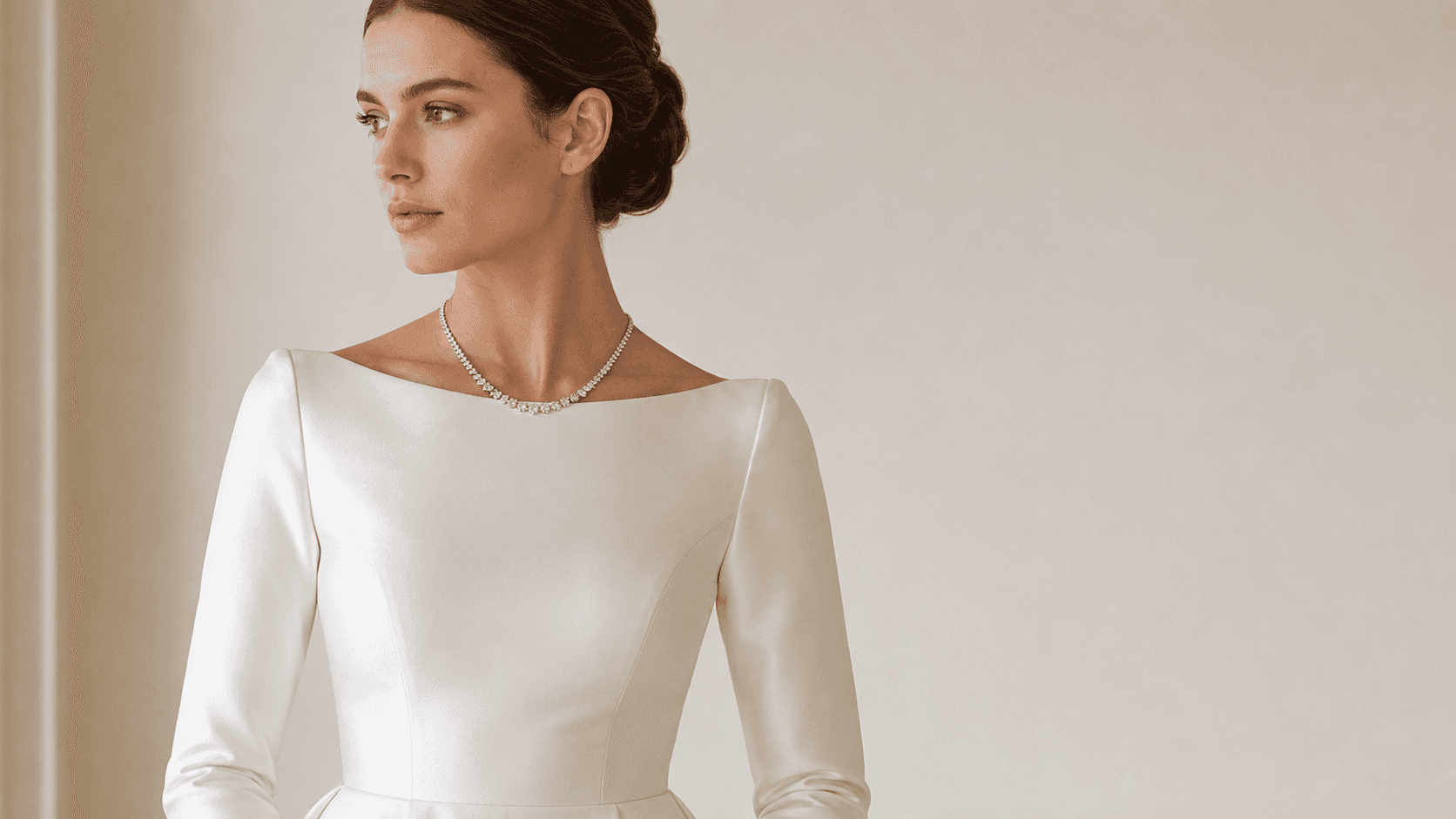
The right diamond necklace should not simply look beautiful in its box. It should belong with your wedding dress—following its neckline, respecting its embellishment and completing the composition without competing for attention.
The quick answer
Choose your wedding dress before choosing your necklace. Match the shape of the necklace to the gown’s neckline, consider how much detail is already present around the bodice and decide where you want the eye to rest. A diamond necklace should frame the bride, not divide the dress into competing focal points.
Begin with the wedding dress—not the diamonds
A necklace can alter the way a wedding dress is perceived. It may make a simple gown feel more formal, emphasize an open neckline or add light to an otherwise minimal look. It can also overwhelm delicate fabric, interrupt a beautifully structured neckline or become lost against heavy embellishment.
This is why the dress should come first. Once the neckline, fabric, bodice and overall mood of the gown are established, the jewellery becomes easier to judge.
The neckline creates open space
Strapless, sweetheart and certain V-neck dresses often leave a natural area that can be framed with a diamond necklace or pendant.
The dress is already the focal point
High necklines, sculptural bodices and heavily embellished gowns may look stronger without a necklace. Diamond earrings can provide light without disturbing the dress.
“The necklace should complete the line of the gown—not interrupt it.”
How to match a diamond necklace to your wedding-dress neckline
The neckline is the most important factor when selecting a necklace. Look at the shape created by the dress and choose jewellery that either follows that shape or sits cleanly within the exposed area.
Strapless
Highly necklace-friendlyA strapless gown creates uninterrupted space across the neck, collarbones and upper chest. This makes it one of the easiest necklines to pair with diamonds.
A short diamond necklace, delicate tennis necklace or refined pendant can work beautifully. A larger statement design may suit a minimal strapless gown, while an embellished bodice usually benefits from something quieter.
Sweetheart
Follow the curveThe soft dip of a sweetheart neckline pairs naturally with necklaces that have a curved or gently descending shape. A central diamond pendant can echo the neckline without reproducing it too literally.
Avoid necklaces that finish directly against the upper edge of the dress. Leaving a little visible skin between the gown and the jewellery helps each element remain distinct.
V-neck
Choose a descending shapeA pendant or graduated necklace that follows the direction of the V creates visual continuity. The necklace does not need to reach the lowest point of the neckline, but it should respect its vertical movement.
A round necklace sitting across a deep V can create two conflicting shapes. A drop design is generally more harmonious.
Square
Keep it structuredSquare necklines have a clear architectural quality. Shorter necklaces, refined collars and symmetrical diamond designs tend to complement that structure.
A pendant can still work, but it should not be so long that it collides with the horizontal edge of the bodice.
Scoop
Soft curves work wellScoop necklines pair easily with rounded or graduated necklaces. A classic diamond necklace can sit comfortably inside the neckline, creating a balanced frame.
Allow the necklace to remain clearly above the dress rather than disappearing beneath its edge.
Bateau or boat neck
Often better withoutA bateau neckline already draws a strong horizontal line from shoulder to shoulder. A short necklace may crowd that line and make the upper part of the look feel busy.
Consider diamond earrings instead. If the dress is exceptionally simple, a longer, restrained necklace may work, but it should be tested with the actual gown.
Halter
Usually skip the necklaceHalter gowns already use the neck and shoulder area as part of their design. Adding a necklace can interfere with the straps and obscure the clean shape.
Diamond studs, drops or sculptural earrings are normally the more coherent choice.
High neck
Let the neckline leadLace, illusion tulle or fabric covering the neck leaves little natural space for a conventional necklace. Jewellery may snag delicate material or become visually confused with the dress.
Unless the gown was specifically designed to be worn with a necklace over the fabric, concentrate the diamonds at the ears, wrist or hands.
Off-the-shoulder
Frame the collarbonesOff-the-shoulder gowns expose the neck and collarbones while creating a strong horizontal line lower on the shoulders. A shorter necklace can sit beautifully within this open area.
If the sleeves or neckline are voluminous, keep the diamonds controlled. The necklace should not fight with dramatic folds, bows or floral details.
One-shoulder
Asymmetry needs restraintThe beauty of a one-shoulder gown lies in its asymmetry. A centred necklace may work against that movement and make the styling feel unnecessarily complicated.
In most cases, earrings or a bracelet are the stronger choice. If you do wear a necklace, choose an exceptionally delicate design and examine the complete look from every angle.
Consider the embellishment, fabric and mood of the dress
Neckline compatibility is only the beginning. Two strapless gowns can require completely different jewellery: one may be a clean silk column, while the other is covered in crystals, pearls and dimensional flowers.
Minimalist wedding dresses
A simple gown gives a diamond necklace room to become a deliberate focal point. A tennis necklace, graduated design or larger pendant can introduce brilliance without creating visual disorder.
Minimal does not automatically mean that the jewellery must be minimal too. The clean surface of the dress may be precisely what allows a stronger piece to look modern and intentional.
Embellished wedding dresses
When a bodice already includes crystals, beading, pearls, metallic embroidery or appliqué, compare the necklace directly with those details. The issue is not merely how much sparkle the dress contains, but whether the two forms of decoration speak the same visual language.
A delicate diamond line may add light without competing. A complex necklace, however, can make the neckline look crowded—especially when embellishment continues onto the straps or illusion panel.
Lace wedding dresses
Lace introduces pattern and texture. With dense lace, a clean diamond design is usually easier to integrate than ornate jewellery with numerous decorative motifs.
Pay attention to the lace edge at the neckline. Scallops, floral appliqués and eyelash trims may already frame the face, reducing the need for another elaborate border.
Satin, mikado and crepe gowns
Smooth fabrics provide a calm background for diamonds. Satin and mikado can support more formal jewellery, while fluid crepe often looks particularly elegant with a restrained pendant or fine diamond necklace.
Vintage-inspired gowns
Consider necklaces that reflect the period referenced by the dress without turning the entire look into costume. An antique or heirloom piece can be especially meaningful, but it should still work with the actual neckline and proportions of the gown.
“More sparkle is not always more bridal. Coherence is what makes the jewellery feel luxurious.”
Which style of diamond necklace should you choose?
Diamond tennis necklace
A continuous line of diamonds creates consistent brilliance around the neck. It works particularly well with strapless, sweetheart, scoop and off-the-shoulder gowns.
Solitaire pendant
A single diamond pendant introduces a focal point without dominating the dress. It is especially compatible with V-neck and sweetheart necklines.
Graduated diamond necklace
Larger stones at the centre create a controlled sense of drama. This style suits open necklines and gowns with relatively restrained bodices.
Diamond drop necklace
A central drop follows the vertical direction of a V-neck or plunging neckline. Check the exact length carefully so the drop does not touch the dress.
Diamond collar or choker
A close-fitting necklace can create a striking frame above a strapless or off-the-shoulder dress. Comfort and precise sizing are particularly important.
Heirloom necklace
An inherited piece adds history and sentiment. Take it to dress fittings rather than assuming it will work from memory or from photographs alone.
Balance the necklace with your proportions
Bridal jewellery should be chosen in relation to the complete person—not through rigid rules about which body types are “allowed” to wear particular pieces.
Consider the visual scale of your features, hairstyle, neckline and gown. A necklace that appears delicate in a product photograph may look substantial on a petite frame, while an extremely fine chain may disappear within a voluminous bridal look.
Necklace length matters just as much as diamond size. The same pendant can sit very differently depending on the wearer’s neck, upper body and the depth of the dress neckline. Adjustable chains are useful, but the final position should be tested while wearing the gown.
White gold, yellow gold, rose gold or platinum?
The metal holding the diamonds influences the character of the necklace, even when relatively little metal is visible.
| Metal | Overall effect | Consider it when |
|---|---|---|
| Platinum | Cool, refined and visually discreet around white diamonds | You want a durable precious metal with a naturally white appearance |
| White gold | Bright, classic and easy to coordinate with cool-toned jewellery | You prefer the appearance of a white metal and already wear white-gold pieces |
| Yellow gold | Warm, traditional or deliberately contemporary | Your everyday jewellery, wedding rings or gown details have warm tones |
| Rose gold | Soft, warm and romantic | It complements your existing jewellery and does not conflict with dress embellishment |
There is no requirement for the necklace metal to disappear against the diamonds. Yellow or rose gold can provide intentional warmth. What matters is that the choice feels connected to the bride, her rings and the complete styling.
If the gown contains metallic embroidery, crystal settings or decorative hardware, compare the colours in natural light. Small differences may be irrelevant from a normal viewing distance, but strongly conflicting metal tones can make an elaborate neckline feel disorganized.
Coordinate the necklace with your earrings, veil and rings
Matching does not require every diamond to have the same shape or every piece to come from a formal set. Coordination is about establishing a clear hierarchy.
If the necklace is the focal point
Choose restrained earrings—such as diamond studs or small drops—and allow the necklace to carry the strongest visual weight.
If the earrings are dramatic
A necklace may be unnecessary. Large drops, chandeliers or sculptural earrings already frame the face and may provide all the brilliance the look requires.
If you are wearing a detailed veil
Embroidery, crystals, lace edges and embellished combs contribute to the overall amount of decoration. View the veil, dress and jewellery together before making a final decision.
Consider the wedding rings—but do not become obsessive
Your engagement ring and wedding band are part of the look, but they are physically separated from the necklace. Mixed metals can appear deliberate and personal. Exact matching is optional, not an obligation.
How to shop for a bridal diamond necklace
Whether you are buying a new necklace, borrowing one or wearing an heirloom, assess the piece through the practical demands of the wedding day as well as its appearance.
Your bridal necklace checklist
- Try it with the actual wedding dress whenever possible.
- Check that the necklace does not touch or catch on the neckline.
- Confirm the length while standing, sitting and moving.
- Examine the clasp and ask whether additional security is advisable.
- Make sure the setting does not snag lace, tulle, hair or the veil.
- View the necklace in daylight and under indoor lighting.
- Photograph the complete look from the front, side and at a normal distance.
- Wear it long enough to assess its weight and comfort.
- Request documentation appropriate to the value and type of piece.
- Arrange suitable insurance, transport and storage when necessary.
Natural or laboratory-grown diamonds
Both natural and laboratory-grown diamonds can provide the brilliance required for bridal jewellery. The right choice depends on your preferences, budget, intended diamond size, sentimental priorities and attitude towards long-term ownership.
Ask the jeweller to explain exactly what you are purchasing, including the diamond origin, treatments, grading documentation, metal, setting and return policy. The description should be clear rather than dependent on vague language such as “diamond-like” or “created stone.”
Do you need a diamond grading report?
Documentation becomes particularly important for valuable pieces and significant individual diamonds. A necklace containing many small stones is assessed differently from a solitaire pendant with one prominent centre diamond.
Ask what documentation accompanies the specific piece and what information it provides. Keep receipts, reports, valuations and photographs together in a secure place.
Consider borrowing or renting
Buying is not the only option. A family necklace may carry greater meaning than a new piece, while a reputable jewellery-rental service may provide access to a design you would not otherwise purchase.
For borrowed or rented jewellery, confirm responsibility, insurance, delivery, return conditions and what happens in case of damage or loss.
Common mistakes to avoid
Buying the necklace first
This can turn the dress search into an unnecessary attempt to accommodate jewellery that may not suit the eventual neckline.
Filling every open space
Visible skin does not automatically require decoration. Sometimes the clean neckline is one of the dress’s strongest features.
Matching only the neckline
Fabric, embellishment, veil, hairstyle and earrings also influence whether the necklace belongs in the final look.
Ignoring exact length
A beautiful necklace can look awkward if it ends against the dress, disappears beneath the bodice or sits too close to the neckline.
Testing only in close-up
Bridal photographs include full-length and mid-distance views. Step away from the mirror and assess the complete silhouette.
Choosing sparkle over coherence
A more expensive or elaborate necklace is not necessarily the better bridal choice. The best piece is the one that strengthens the gown.
Frequently asked questions
Should a bride always wear a necklace?
No. High-neck, halter, one-shoulder and heavily embellished wedding dresses often look stronger without one. Earrings, a bracelet or the bride’s rings may provide sufficient jewellery.
What diamond necklace works best with a strapless wedding dress?
Strapless gowns work with many styles, including tennis necklaces, short graduated designs, collars and pendants. The amount of detail on the bodice should determine how restrained or dramatic the necklace should be.
What necklace should I wear with a V-neck wedding dress?
A pendant or drop necklace that follows the descending shape of the neckline is generally the most harmonious option. Check that its lowest point remains clearly above the dress.
Can I wear a diamond necklace with a heavily beaded gown?
Yes, but it should be assessed carefully. A fine diamond necklace may complement the gown, while an elaborate design can compete with the beadwork. Trying everything together is essential.
Should my necklace match my engagement ring?
It can, but exact matching is unnecessary. A shared metal colour, diamond shape or degree of formality may create cohesion, while thoughtfully mixed metals can also look elegant.
Should I choose my bridal necklace before my veil?
Ideally, assess the dress, veil and jewellery together. A highly embellished veil may change how much jewellery the look can support.
Can I wear a coloured gemstone with a diamond necklace?
Yes. A coloured centre stone or gemstone detail can introduce personal meaning or connect the jewellery to another part of the wedding look. The colour should feel intentional rather than accidentally mismatched.
Let the gown make the decision
The perfect bridal necklace is not necessarily the largest, brightest or most traditional option. It is the one that appears inseparable from the finished look—beautiful on its own, but even better because of the wedding dress beneath it.