
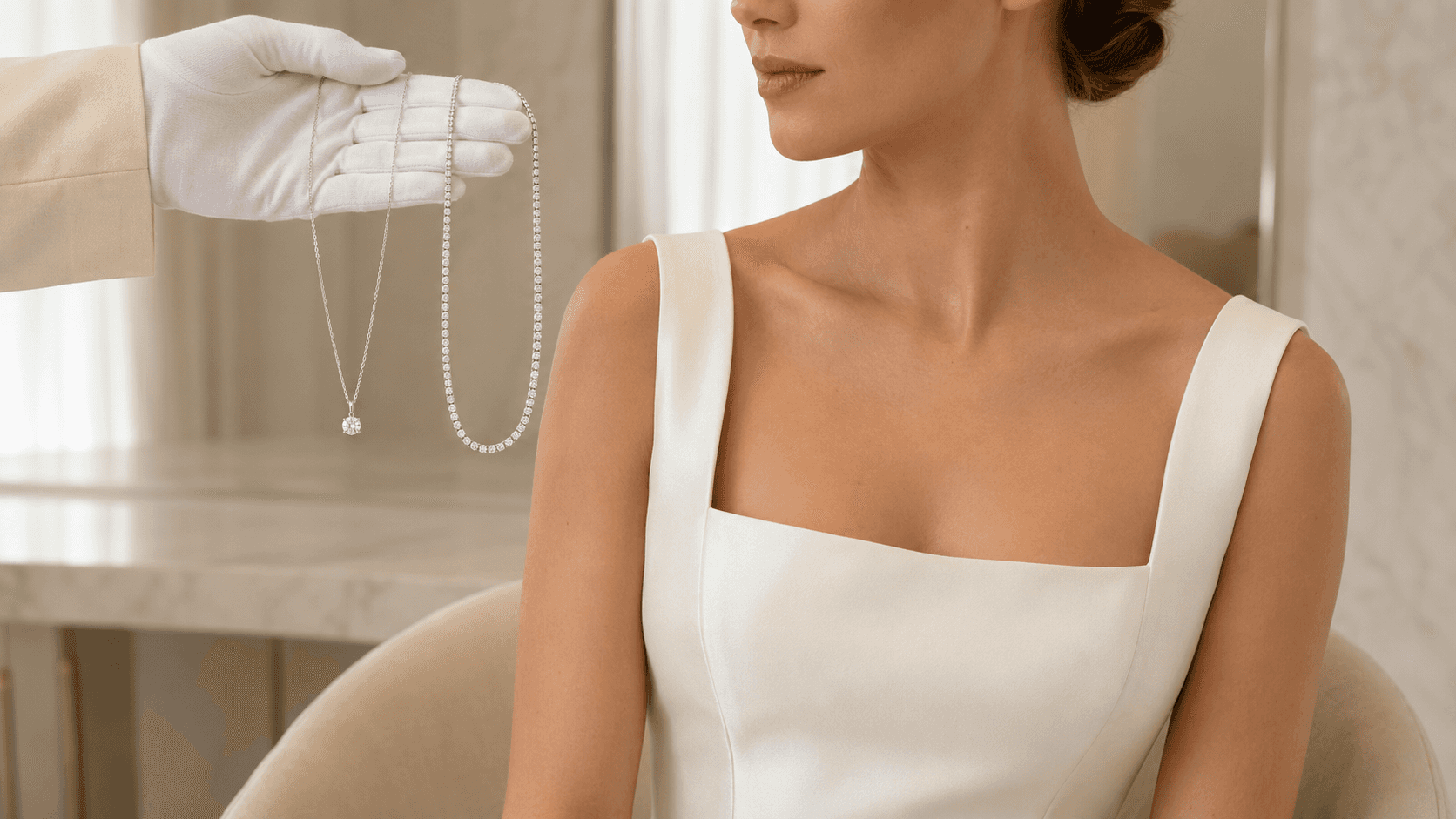
A bridal diamond necklace may be a delicate detail, a significant investment or an heirloom intended to outlive the wedding itself. Understanding necklace styles, diamond settings and the factors that influence price will help you spend deliberately—without paying for qualities that disappear once the necklace is worn.
What should a bride look for?
Begin with the wedding dress and decide how prominent the necklace should be. Compare complete designs rather than diamond size alone, ask whether carat figures refer to one stone or the entire necklace, inspect the security and finish of the setting, and establish a budget that includes the chain, metal, craftsmanship, documentation and possible alterations—not only the diamonds.
Before you begin: decide what the necklace needs to do
“A diamond necklace” can describe anything from a fine chain with one small solitaire to a continuous rivière of individually set stones. Before comparing prices, decide what role the necklace will play.
A bridal detail
The necklace is selected primarily to complete the wedding dress and may be delicate enough to recede into the complete look.
An everyday piece
A pendant or restrained diamond necklace can be worn after the wedding with shirts, dresses and evening looks.
A lasting jewel
The purchase is intended as an heirloom or major jewellery investment, making construction, documentation and long-term maintenance especially important.
Also decide whether the necklace or the gown should command attention. If the dress has a heavily embroidered bodice, elaborate lace or crystal embellishment, a fine necklace may be enough. A clean strapless gown can support a much stronger piece.
“The most expensive necklace is not automatically the most successful one. The successful necklace makes the entire bride look more considered.”
Diamond necklace styles explained
Style has a significant effect on price because it determines how many diamonds are required, how complex the setting must be and how much precious metal and labour are involved.
Solitaire pendant
A single diamond suspended from a chain creates one clear focal point. It is easy to wear after the wedding and works particularly well with V-neck and sweetheart gowns.
Price is influenced heavily by the quality and size of the central diamond, as well as the metal and construction of the chain.
Diamond station necklace
Individual diamonds are positioned at intervals along a chain. The result is lighter and less formal than a continuous diamond necklace.
Check whether the stones remain facing forward or tend to flip as the necklace moves.
Tennis necklace
A flexible line of diamonds encircles the neck. This style may use similarly sized stones throughout or feature subtle graduation towards the centre.
Total carat weight, necklace length, stone consistency and setting quality all contribute significantly to the final price.
Graduated necklace
Diamonds increase in size towards the centre, directing attention towards the face and neckline. Graduation can create greater visual impact without requiring equally large stones around the entire neck.
Drop or Y-necklace
A central drop follows the direction of a V-neck or plunging gown. The exact length must be tested carefully to keep the pendant clear of the dress.
Diamond collar or bib necklace
A broad or closely fitted design can become the principal feature of a minimalist bridal look. These necklaces involve more stones, metal and complex articulation, making construction quality essential.
Cluster necklace
Several smaller diamonds are arranged to create a floral, geometric or larger composite shape. Clusters can provide substantial visual presence without relying on one large stone.
Diamond motif pendant
Initials, stars, crosses, flowers and abstract forms create a more individual piece. Consider whether the motif belongs naturally with the gown and remains meaningful after the wedding.
Diamond necklace settings: what they look like and how they behave
The setting holds each diamond in place. It affects security, brilliance, smoothness, flexibility and the amount of visible metal. No setting is universally superior; the best option depends on the necklace style and how it will be worn.
| Setting | Appearance | Advantages | What to check |
|---|---|---|---|
| Prong | Fine metal claws hold each diamond | Allows substantial light around the stones and keeps metal relatively discreet | Prongs should be even, secure and smooth enough not to catch fabric or hair |
| Bezel | A metal rim surrounds the diamond | Protective, smooth and distinctly modern | More metal is visible and can alter the apparent outline of the stone |
| Channel | Diamonds sit between parallel walls of metal | Creates a clean line with no prongs between individual stones | Usually suits rows of appropriately shaped stones; repairs and resizing may be complex |
| Pavé | Small diamonds cover a surface with minimal visible metal | Produces fine, continuous sparkle and intricate detail | Inspect the consistency of the work and ask about maintenance if a small stone is lost |
| Halo | Small diamonds surround a central stone | Increases visual presence and adds brilliance around the centre | The halo should look balanced rather than obscuring the central diamond |
| Cluster | Multiple diamonds form one larger decorative unit | Offers impact, texture and design flexibility | Ensure the arrangement is symmetrical and individual stones are securely held |
Security matters more than invisibility
Buyers often want the setting to disappear, but excessively delicate construction may be unsuitable for a necklace intended for frequent wear. The stones need enough support, and the links between sections must move without twisting or creating weak points.
Check every surface that may touch the dress
Run a finger carefully along the back and edges of the necklace. Rough prongs, unfinished joins and sharp corners can catch lace, tulle, veils or hair. This is particularly important for an embellished bridal gown that will already involve delicate materials.
How to assess the diamonds in a necklace
The familiar four Cs—cut, colour, clarity and carat—remain relevant, but they function differently in a necklace containing many stones than in a solitaire engagement ring.
Prioritize visible brilliance
Cut influences how effectively a diamond handles light. In a necklace, the stones should appear lively and reasonably consistent rather than alternating between bright and noticeably dull.
Look for consistency
Small differences may be difficult to see once the necklace is worn, but obviously mismatched stones can disrupt a continuous design. Metal colour also changes how diamond colour is perceived.
Buy for the way it looks
Extremely high clarity grades may add cost without creating an equally visible difference at normal viewing distance, especially when the necklace contains numerous small stones.
Understand what the number means
Carat measures diamond weight, not the dimensions of the finished necklace. In multi-stone jewellery, the advertised figure may represent total carat weight across every diamond.
Total carat weight is not the size of each diamond
A tennis necklace described with a particular total carat weight divides that weight among many stones. Ask for the number of diamonds, approximate individual stone size and necklace length before comparing it with another piece.
Matching matters in multi-stone necklaces
Individual diamonds in a continuous necklace should work as an ensemble. Consistency in apparent size, shape, colour and brightness may be more important to the finished result than obtaining an exceptional grade for one isolated stone.
Diamond shape changes the character of the necklace
Round brilliant diamonds create a classic line of sparkle. Emerald and baguette cuts offer a cleaner, more architectural effect. Pear, marquise and oval diamonds can introduce movement and decorative rhythm. Mixed shapes create greater individuality but require careful design to remain coherent.
“Do not pay for a specification you cannot appreciate while wearing the necklace.”
Natural or laboratory-grown diamonds?
Natural and laboratory-grown diamonds have the same fundamental crystal material, but they differ in origin, market positioning, price structure and the meaning individual buyers attach to them.
Why a bride might choose natural diamonds
Natural diamonds may appeal because of their geological origin, traditional association with fine jewellery, perceived rarity or suitability for a piece intended as an heirloom. For some buyers, those qualities are part of the emotional value of the necklace.
Why a bride might choose laboratory-grown diamonds
Laboratory-grown diamonds may allow a bride to choose larger stones or a more substantial necklace within the same initial budget. They can be especially attractive for designs requiring many diamonds, such as tennis or graduated necklaces.
Ask for precise disclosure
The seller should clearly identify whether the diamonds are natural or laboratory-grown and provide appropriate documentation. Avoid listings that depend on ambiguous phrases such as “diamond alternative,” “diamond-style” or “created crystal” without explaining the actual material.
Choosing the metal for a diamond necklace
Metal influences the appearance, durability, maintenance and price of the necklace. It should also be considered alongside the bride’s rings, other jewellery and any metallic details on the gown.
Platinum
Platinum has a naturally white appearance and is associated with substantial fine-jewellery construction. It is dense and may make a large necklace feel heavier than expected.
White gold
White gold provides a bright setting around diamonds and is widely used for bridal jewellery. Ask about the alloy and any surface treatment or maintenance it may require.
Yellow gold
Yellow gold creates visible warmth and can make the necklace feel traditional, vintage-inspired or distinctly modern, depending on the design.
Rose gold
Rose gold offers a softer warm tone. It can be particularly effective when it connects naturally with the bride’s existing jewellery and overall colour palette.
If you have sensitivities or allergies, ask for the complete alloy composition rather than relying only on the general metal name. Also confirm whether the chain, clasp and setting are made from the same material.
How much should you budget for a bridal diamond necklace?
There is no correct bridal-jewellery budget. The appropriate amount depends on whether the necklace is primarily a wedding accessory, an everyday purchase or an important addition to a long-term jewellery collection.
Begin with a maximum amount that does not compromise priorities such as the dress, alterations, photography or essential wedding expenses. Then decide which necklace characteristics matter most within that limit.
Set the total limit
Include taxes, delivery, insurance, chain alterations, independent valuation and any immediate maintenance—not only the advertised price.
Choose the desired effect
Decide whether you want one visible centre diamond, fine brilliance across the neck or a substantial statement design. These goals distribute the budget differently.
Select your priorities
Rank diamond origin, visible size, cut, metal, craftsmanship, brand, documentation and long-term wear rather than trying to maximize every feature.
Compare complete pieces
Two necklaces with the same total carat weight can differ dramatically in stone quality, length, flexibility, setting construction and overall appearance.
A smaller budget
Consider a fine solitaire pendant, a laboratory-grown diamond, a pre-owned piece or a delicate station necklace. Concentrating the budget into one visible diamond may create more impact than spreading it across many extremely small stones.
A moderate budget
You may be able to choose between a stronger solitaire, a refined multi-stone pendant, a delicate tennis necklace or a more distinctive designer piece. Compare construction and wearability rather than automatically choosing the greatest carat figure.
A substantial budget
More elaborate tennis, graduated, collar and antique necklaces become possible. At this level, provenance, independent documentation, craftsmanship, insurance and aftercare deserve as much attention as appearance.
Where to spend—and where you may be able to save
Construction and security
Secure stones, smooth settings, reliable links and a strong clasp directly affect whether the necklace survives regular wear.
Visible consistency
In a multi-stone necklace, well-matched diamonds create a more luxurious overall impression than a technically impressive specification attached to an uneven finished piece.
Unnecessarily high clarity
Minute inclusions that cannot be seen in normal wear may have little effect on the beauty of small necklace diamonds. Compare appearance, not only grade labels.
Brand premium
An established house may offer desirable design, service and provenance, but part of the price may reflect the name. Decide whether that identity matters to you.
Pre-owned and antique jewellery
Pre-owned pieces can offer unusual craftsmanship and character. Condition, repairs, replaced stones, documentation and return conditions should be investigated carefully.
Borrowing or renting
An heirloom or rented necklace can provide substantial bridal impact without requiring a new purchase. Confirm responsibility, insurance and return arrangements in writing.
Quality is more than diamond grades
A necklace is a moving object. It must curve around the neck, remain correctly oriented and withstand repeated contact with skin, hair and clothing. Excellent stones cannot compensate for uncomfortable or unreliable construction.
Flexibility
A continuous diamond necklace should articulate smoothly without creating rigid corners. Test whether it follows the neck naturally and returns to its proper position after movement.
Balance
Pendants should remain centred, while necklaces with decorative front sections should not rotate continually. The clasp and rear construction influence balance as much as the visible stones.
Clasp security
Examine how the clasp closes and whether the necklace includes an additional safety mechanism. A valuable necklace should not rely on a closure that feels loose, ambiguous or difficult to verify.
Comfort
Wear the necklace for more than a few minutes. Check its weight, the movement of individual links and whether any setting scratches, pinches or catches.
Finish
Inspect the reverse as well as the front. The underside should appear carefully completed, with smooth edges and no obvious construction shortcuts.
Documentation, returns and insurance
Appropriate documentation depends on the type and value of the necklace. A significant solitaire pendant may include a report for its central diamond, while a necklace composed of many small stones may be documented by total weight and stated quality ranges.
Ask exactly what is included, what has been independently assessed and what information comes solely from the seller. Keep invoices, grading reports, valuations, photographs and service records together.
Read the return policy before purchasing
Confirm the return period, permitted condition, responsibility for insured shipping and whether resizing, engraving or other alterations make the necklace non-returnable.
Arrange suitable insurance
Depending on the value, ordinary household or travel cover may be insufficient. Ask an appropriate insurer how the piece should be valued, transported and stored, and whether it is covered outside the home or abroad.
Plan wedding-day custody
Decide who will bring the necklace, when it will be put on and who will secure it after the celebration. Valuable jewellery should not be left unattended in a dressing room, hotel room or unverified storage location.
Questions to ask before buying
- Are the diamonds natural, laboratory-grown or another material?
- Does the listed carat figure refer to one diamond or total carat weight?
- How many diamonds does the necklace contain?
- What information is available about cut, colour and clarity?
- What metal and alloy are used for the settings, chain and clasp?
- What type of setting holds the diamonds?
- Does the necklace include a safety clasp or secondary security feature?
- Can the length be adjusted without compromising the design?
- What documentation accompanies the necklace?
- Has a pre-owned piece been repaired or had stones replaced?
- What maintenance and cleaning are recommended?
- What are the return, warranty and aftercare conditions?
- Can the necklace be tried with the wedding dress before the final decision?
Frequently asked questions
What is the most versatile diamond necklace for a bride?
A refined solitaire pendant or delicate tennis necklace is generally easy to wear after the wedding. The best choice still depends on the bride’s usual style and the neckline of the gown.
What does total carat weight mean?
Total carat weight combines the weight of all diamonds in a piece. In a multi-stone necklace, it does not describe the weight of each individual diamond.
Which setting makes diamonds look larger?
Halo and cluster designs can create a larger overall visual outline, while fine prong settings expose more of each stone. Apparent size also depends on diamond shape, spacing and the amount of visible metal.
Is a bezel setting suitable for bridal jewellery?
Yes. A bezel setting can look clean and modern while providing substantial protection around the diamond. It displays more metal than a fine prong setting, which may be either an advantage or a disadvantage depending on the desired look.
Are laboratory-grown diamonds suitable for a bridal necklace?
Yes. They may allow a larger or more diamond-intensive design within a particular initial budget. Buyers should receive clear disclosure about origin and understand the purchase they are making.
Should I buy a diamond necklace online?
Online purchasing can work when the seller provides clear specifications, detailed imagery, appropriate documentation, secure delivery and a usable return policy. For an important purchase, independent verification may also be considered.
Should my bridal necklace match my engagement ring?
Exact matching is not required. The pieces can be connected through metal colour, diamond shape, period or overall degree of formality without belonging to an identical set.
Can a diamond necklace be altered to suit my dress?
Some chains and pendants can be shortened or fitted with additional adjustment points. Continuous tennis, graduated and complex necklaces may be more difficult to alter. Ask a qualified jeweller before purchasing.
When should I buy my bridal necklace?
Choose it after the wedding dress and preferably early enough to test it during a fitting. This leaves time for returns, alterations, cleaning, valuation or insurance arrangements.
Buy the necklace you will value—not the specification you were told to want
The best diamond necklace for a bride balances beauty, construction, comfort and cost. Look beyond carat totals, compare the complete piece and choose the qualities that remain meaningful both on the wedding day and in the years that follow.