
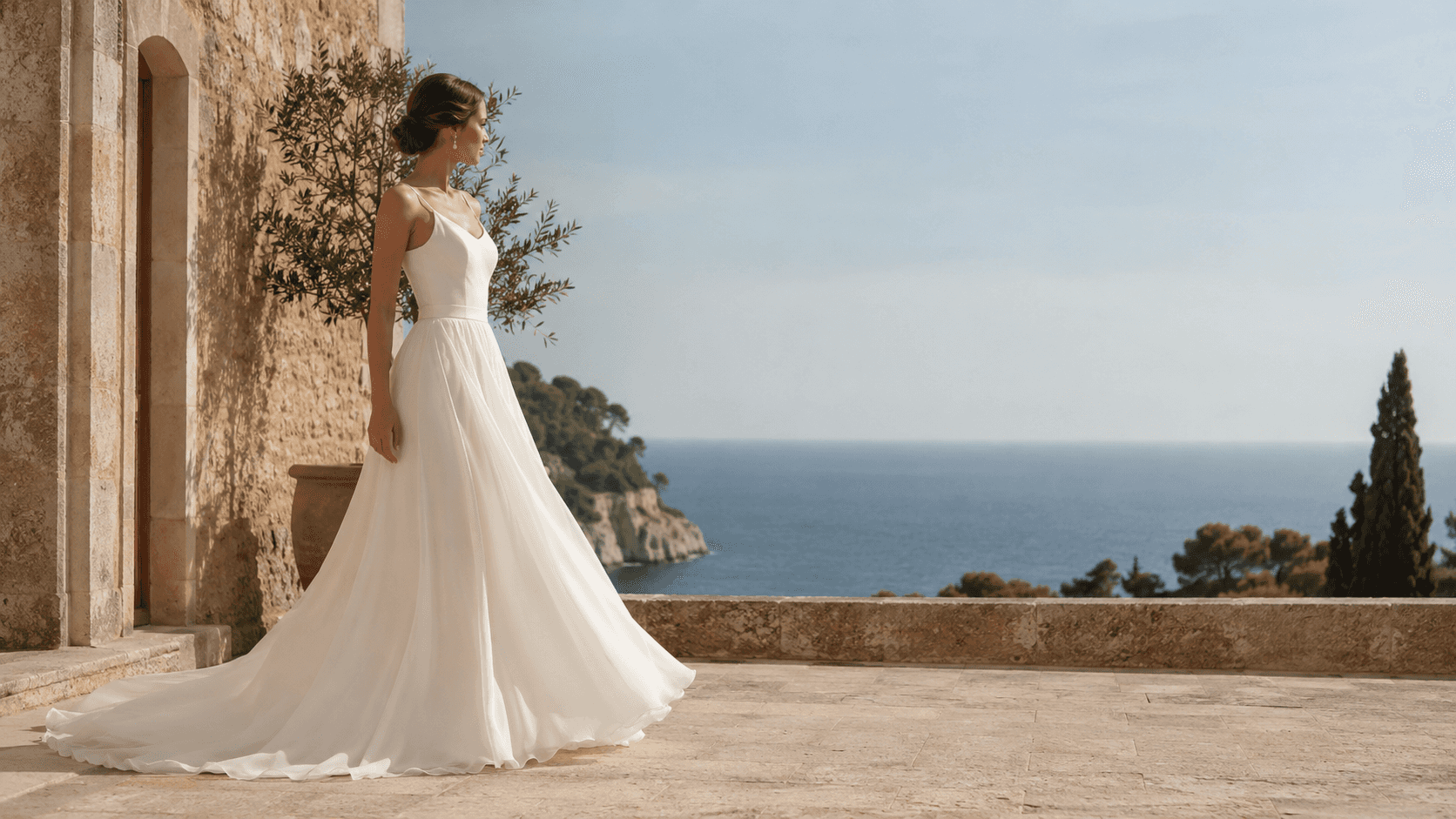
The best wedding dress for Mallorca—or any European summer wedding—must do more than look beautiful in photographs. It must remain wearable through heat, travel, outdoor ceremonies, uneven stone paths and celebrations that continue long after sunset.
What wedding dress works best for a European summer wedding?
Look for a gown with breathable construction, manageable weight and enough movement for the venue. Crepe, chiffon, organza, fine tulle and lighter silks are strong options. Clean column dresses, fluid A-lines, slip gowns and softly structured silhouettes generally travel and move more easily than heavily layered ball gowns.
Choose for your actual destination—not the fantasy version of it
“European summer wedding” can describe a seaside ceremony in Mallorca, a formal celebration in a Roman palazzo, a vineyard wedding in Tuscany, a Greek-island terrace or a château garden in France. These settings may share warm weather, but they do not create identical practical demands.
Before shopping, establish where the ceremony, photographs, dinner and dancing will take place. Consider the surfaces between them, whether the venue is air-conditioned and how much time you will spend outside.
Heat and sun
Ask how the temperature usually changes between the ceremony and evening, and whether shade is available during the hottest hours.
Sand, gravel or stone
Long trains and delicate hems behave differently on beaches, old paving, terracotta terraces and manicured lawns.
Beach, villa or church
The dress may need to satisfy both the visual mood of the venue and practical or religious requirements.
“Destination bridal style works when romance and logistics reach the same decision.”
The best wedding-dress styles for Mallorca and European summer weddings
Fluid A-line
An A-line gown provides movement and ceremony without requiring the weight of a full ball-gown skirt. Look for soft layers, restrained underskirts and breathable lining.
Column dress
A column follows a relatively straight vertical line and can feel elegant in villas, city venues and seaside settings. Make sure the skirt allows a natural walking stride.
Slip dress
A bias-cut or fluid slip gown suits relaxed celebrations and travels more easily than heavily constructed styles. The simplicity makes fit, fabric and undergarments especially visible.
Chiffon gown
Chiffon creates softness without excessive bulk. It moves attractively in a breeze, although multiple layers can still become warm and should be checked individually.
Organza dress
Organza offers volume with less visual heaviness than many dense fabrics. It can support architectural or romantic silhouettes while retaining a sense of lightness.
Convertible gown
Detachable overskirts, sleeves, capes and trains can create formality for the ceremony and a lighter configuration for dinner and dancing.
Can you wear a fitted gown?
Yes. A fitted wedding dress can work beautifully for a summer destination wedding, but construction matters. A lighter crepe or softly structured fit-and-flare may be more comfortable than a heavily corseted gown with dense embellishment and multiple synthetic linings.
Can you wear a ball gown?
Also yes. The destination does not forbid grandeur. A lightweight organza ball gown may feel easier than a deceptively simple dress built from several dense layers. Investigate the actual weight, petticoat structure and ventilation rather than judging only by silhouette.
The best wedding-dress fabrics for warm weather
Fabric choice matters, but the fibre label alone cannot tell you whether a finished gown will feel cool. Thickness, weave, lining, layering and internal structure all affect comfort.
| Fabric | Why it works | What to check |
|---|---|---|
| Chiffon | Fluid, light-looking and responsive to movement | Number of layers, transparency and static |
| Organza | Creates volume while retaining an airy appearance | Stiffness, scratching and how easily it creases |
| Crepe | Clean, fluid and suitable for understated silhouettes | Fabric weight, lining and whether perspiration marks become visible |
| Fine tulle | Provides soft volume with visual lightness | Total number of layers and whether the fabric catches on the venue surface |
| Lightweight silk | Can feel fluid, luxurious and naturally connected to the body | Creasing, moisture sensitivity and care requirements |
| Lace | Creates texture and romantic detail without relying on heavy decoration | Density, backing, lining and whether the lace feels rough in heat |
| Mikado | Offers clean structure and a formal finish | Weight and whether the gown contains substantial internal support |
| Satin | Creates a smooth, formal and luminous surface | Weight, fibre content, lining and visible moisture |
“Lightweight” is not a complete description
A light outer fabric may conceal several layers of lining, shapewear, boning and underskirts. Ask to see or feel every layer contributing to the finished gown.
What makes a wedding dress breathable?
Breathability is determined by the entire dress construction. The most important heat may come not from the visible fabric but from synthetic linings, foam cups, dense corsetry and multiple layers held close to the body.
Fewer unnecessary layers
Ask whether volume can be achieved with lighter construction and whether any underskirt layers can be safely removed during alterations.
Strategic structure
Support does not need to mean wrapping the entire torso in dense material. Well-placed boning and cups may provide security with less bulk.
Comfortable lining
The lining touches your skin for hours. Check its texture, breathability and behaviour under warm conditions.
Freedom of movement
A gown that restricts the stride or compresses the ribcage can become exhausting more quickly in hot weather.
During fittings, remain in the dress for long enough to notice heat accumulation. Sit, walk, raise your arms and breathe deeply. A gown can feel comfortable for three minutes and oppressive after thirty.
What to wear for different European summer destinations
Mallorca or Ibiza
Consider fluid A-lines, minimalist columns, slip dresses, fine lace and detachable overskirts. A finca or formal estate can support more structure than a ceremony directly beside the sea.
Account for sun, breeze, terraces, stone steps and the transition between an outdoor ceremony and late-night dancing.
Greek islands
Lightweight gowns with controlled volume work well in strong light and coastal wind. Secure draped elements and avoid assuming that every airy cape or veil will remain arranged as it did indoors.
Stairs, slopes and irregular paths make manageable hems and dependable footwear particularly valuable.
Italian villa or vineyard
Crepe columns, silk gowns, organza A-lines and softly structured dresses suit the combination of landscape and formality.
Consider gravel, grass, old stone and potential religious requirements if the ceremony takes place in a church.
Rome, Florence or Paris
City weddings can support more architectural and formal gowns, but summer heat and walking remain real concerns. A clean silhouette with a manageable train may be more practical for moving between locations.
Historic interiors can vary enormously in temperature, access and flooring. Confirm the route rather than assuming continuous air conditioning.
French château
Romantic A-lines, organza skirts and more formal gowns can suit the setting. Investigate whether photographs and cocktails take place on gravel, lawn or interior floors.
Evening temperatures may fall more noticeably than at southern coastal destinations, making a cape, jacket or sleeve option useful.
Portugal or southern Spain
Strong sun and high temperatures favour breathable construction and thoughtful timing. Architectural gowns, fluid crepe and controlled volume can all work.
A formal location does not require a physically punishing dress. Structure can be created through cut rather than sheer weight.
Consider the ceremony and venue requirements
A destination gown must sometimes move between different standards of dress. A civil ceremony, religious building, seaside dinner and dance floor may each require a slightly different degree of coverage or practicality.
Religious ceremonies
Ask the specific church or officiant about neckline, shoulder coverage, skirt transparency and other requirements. Do not rely solely on general assumptions about the country or denomination.
Detachable sleeves, a refined cape, jacket or appropriate veil may provide coverage without dictating the entire evening look.
Outdoor ceremonies
Establish where the bride will wait before entering, how long the ceremony lasts and whether direct shade is available. An outdoor ceremony at midday creates different demands from one beginning near sunset.
Historic venues
Narrow doorways, old staircases and protected floors can influence skirt width and train length. Ask whether candles, rough walls or fragile furnishings create additional restrictions.
“A summer dress does not need to look casual. It needs to be intelligently constructed.”
How long should the train be?
A train can create drama without making the entire gown heavier, but it also collects dust, catches on uneven ground and complicates movement.
Sweep train
Provides a bridal finish with relatively little fabric trailing behind. It is one of the easiest options for travel and outdoor movement.
Chapel train
Offers more ceremony while remaining manageable with a well-designed bustle and help during transitions.
Cathedral train
Creates undeniable impact but requires sufficient aisle space, careful handling and a realistic plan for outdoor surfaces.
Detachable train
Allows a dramatic entrance and photographs before being removed for dinner and dancing.
Confirm how the dress will be bustled and test the finished bustle during alterations. A badly positioned bustle can add weight at the back, distort the silhouette or come undone during the reception.
Veils, shoes and accessories for a destination gown
The veil
Fine tulle may appear almost weightless, but a long veil becomes difficult in strong wind and may pull against the hair. Ask how it will be secured and whether it can be removed easily after the ceremony.
For a seaside or exposed terrace, a shorter veil, controlled drop veil or no veil may be more manageable than an elaborate cathedral design.
The shoes
Choose for the actual surface. Narrow heels may sink into grass or become trapped between old stones. Block heels, secure sandals, flats or discreet heel protectors may provide greater stability.
Jewellery
Summer light can make diamonds and reflective details highly visible. Allow either the dress or jewellery to lead instead of adding embellishment simply because the celebration is formal.
An evening layer
Coastal wind and late-night temperature changes can make a silk jacket, cape, stole or detachable sleeve useful even after a hot afternoon.
How to travel with your wedding dress
Before buying, ask how the gown should be packed, transported, steamed and stored. Some apparently effortless fabrics require considerable care after travel.
Destination dress travel checklist
- Ask the designer or boutique for exact transport instructions.
- Confirm airline rules before arriving at the airport.
- Use an appropriate garment bag with the dress properly supported.
- Do not assume cabin crew can store the gown separately.
- Carry essential accessories and documentation with you.
- Arrange professional steaming at the destination in advance.
- Confirm who will receive and store the gown on arrival.
- Keep the dress away from food, cosmetics and excessive humidity.
- Bring an emergency kit appropriate to the fabric and fastenings.
- Plan how the dress will be packed after the wedding.
Alterations for a European summer wedding
Tell the seamstress where and when the wedding will take place. Summer conditions and destination logistics may affect hem length, lining, support and bustle construction.
Prioritize secure support
A strapless or low-backed dress should remain secure without requiring constant pulling. Support that works only while standing still will become frustrating during a long, active wedding day.
Leave enough room to breathe
A precisely fitted bodice should support the body without preventing a full breath or becoming painful after eating, sitting and moving in the heat.
Set the hem with the actual shoes
Bring the shoes—and any planned alternative pair—to the fitting. If changing heel height, confirm that the finished hem remains manageable.
Test every detachable element
Practise removing sleeves, overskirts, trains and capes. Assign someone to help and ensure that the dress looks complete in both configurations.
Common destination wedding-dress mistakes
Choosing from photographs alone
A gown can look weightless while concealing dense lining, heavy boning and numerous underskirt layers.
Treating “beach” as a dress code
A beach destination does not force the bride into a casual slip dress. Venue formality and personal style still matter.
Ignoring the walking route
The journey between ceremony, photographs and dinner may involve more stairs, gravel and old stone than expected.
Assuming natural fabric means cool
A dense natural fabric with several linings may feel warmer than a carefully constructed alternative.
Forgetting the evening
A gown selected only for the afternoon heat may feel incomplete once the celebration moves into a formal interior or cooler night.
No steaming plan
Travel creases are predictable. A trusted professional and suitable location should be arranged before arrival.
Frequently asked questions
What is the best wedding dress for a Mallorca wedding?
Fluid A-lines, minimalist columns, slip dresses, organza gowns and lightweight lace designs are strong options. The right choice depends on whether the wedding takes place at a beach, finca, hotel or formal estate.
Can I wear a ball gown to a European summer wedding?
Yes. Choose a thoughtfully constructed gown and investigate its actual weight, lining and underskirt structure. Lightweight organza can create considerable volume without the density of some other fabrics.
What wedding-dress fabric is best for hot weather?
Chiffon, organza, fine tulle, fluid crepe and certain lightweight silks can work well. The number of layers, lining and internal construction matter as much as the outer fabric.
Should a destination wedding dress have a train?
It can. Sweep and chapel trains are generally easier to manage, while detachable trains offer ceremony impact with greater reception freedom. Consider the venue surface and bustle design.
Can I wear long sleeves at a summer wedding?
Yes, particularly when the sleeves are made from light lace, tulle or another breathable construction. Dense fitted sleeves may become uncomfortable, so test them in warm conditions.
How should I transport my wedding dress abroad?
Follow the designer or boutique’s packing instructions, check airline rules and arrange suitable storage and steaming at the destination. Do not assume a separate aircraft wardrobe will be available.
Should I buy a second dress for the reception?
Only if you genuinely want one. A bustle, detachable train or removable overskirt may provide enough transformation without requiring a second gown.
When should I begin shopping for a destination wedding dress?
Begin early enough to account for production, fittings, accessories and international travel planning. Confirm the designer’s timeline rather than relying on a universal schedule.
Choose the gown that can live through the destination
The best European summer wedding dress preserves its beauty while allowing the bride to walk, breathe, celebrate and remain present. The destination should influence the gown—but it should never erase the bride’s personal style.