
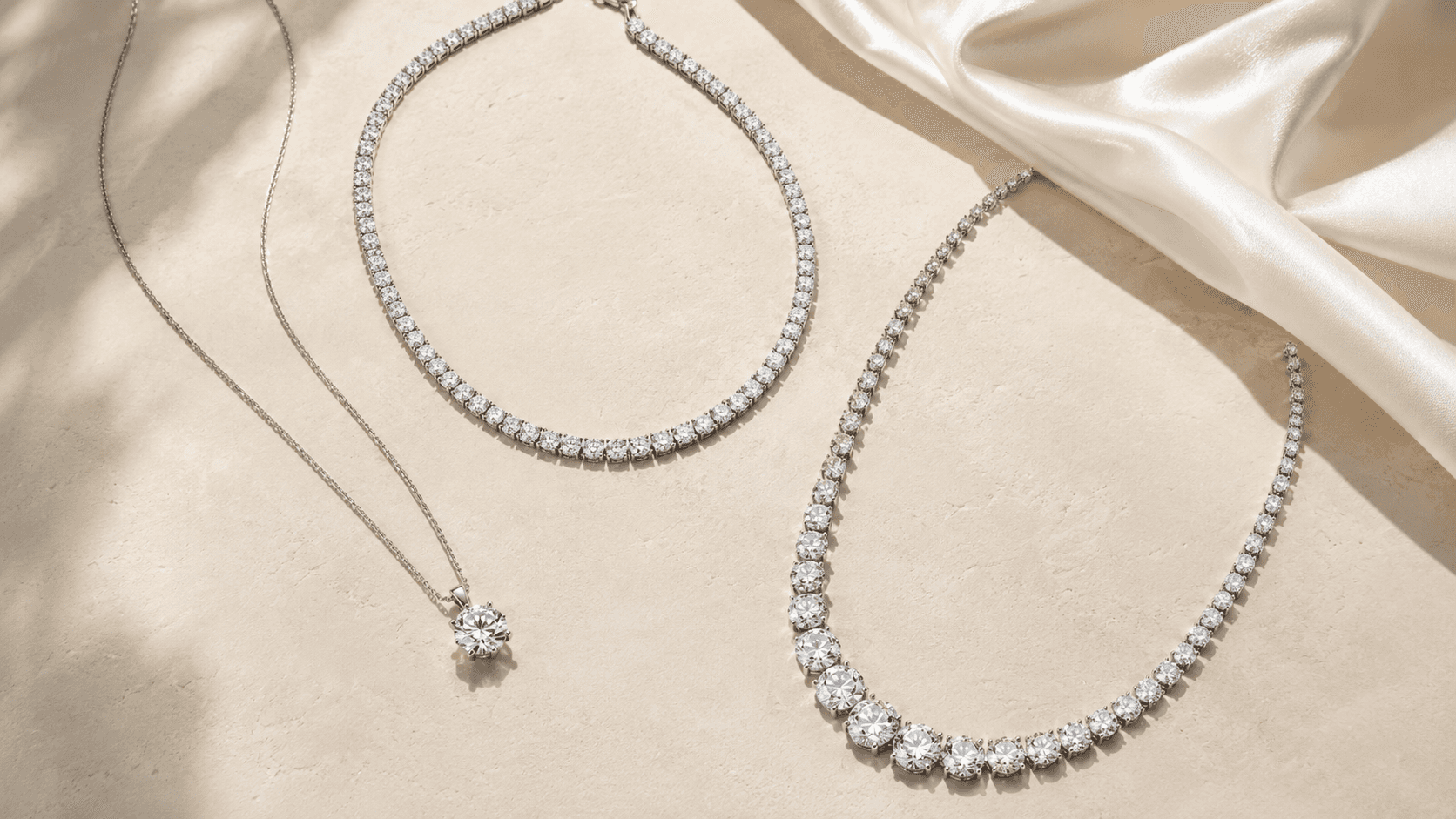
Selecting a diamond necklace is not simply a matter of choosing the brightest design. The right piece must suit your wedding dress, proportions and personal style while meeting practical standards for quality, comfort and security.
How do you select the right diamond necklace?
Start with the occasion and the clothing you intend to wear. Choose a necklace shape that complements the neckline, establish the right length, decide how much visual presence you want and compare the diamonds as part of the complete design. Finally, inspect the construction, clasp and comfort before making your decision.
A seven-step process for selecting a diamond necklace
The number of available designs can make diamond-necklace shopping feel unnecessarily complicated. A clear order of decisions prevents you from comparing pieces that were never suitable for the same purpose.
Define its purpose
Decide whether the necklace is primarily for the wedding, for frequent wear afterwards or as a significant heirloom. A highly specific bridal statement necklace serves a different purpose from an understated pendant intended for daily use.
Begin with the dress
Note the exact neckline, bodice detail, fabric and overall style of your wedding gown. The necklace should respond to the dress rather than forcing the dress to accommodate it.
Choose the visual scale
Decide whether you want a subtle point of light, a continuous line of diamonds or a dramatic focal piece. This decision quickly eliminates many unsuitable options.
Establish the length
Measure the available space above the gown and determine where the necklace should finish. Length affects whether the piece frames the neckline or conflicts with it.
Set your priorities
Rank the qualities that matter most: visible size, diamond origin, brilliance, metal, craftsmanship, versatility, brand or sentimental value.
Inspect the complete piece
Evaluate how the diamonds, settings, chain, links and clasp work together. A necklace is more than the sum of its diamond specifications.
Try it with everything
Wear the necklace with the wedding dress, earrings, veil and intended hairstyle. Examine the entire silhouette in natural light and in photographs before making the final decision.
“Select the necklace for the complete woman and the complete dress—not for an isolated jewellery photograph.”
Match the necklace to your bridal style
Your wedding dress establishes a visual language. The necklace does not have to replicate every detail, but it should feel as though it belongs in the same composition.
Minimalist bride
Consider a solitaire pendant, precise tennis necklace or sculptural bezel-set design. A simple gown can support either restrained jewellery or one deliberately strong statement.
Romantic bride
Graduated diamonds, gentle drops and floral clusters can complement soft fabrics and curved necklines. Keep the jewellery controlled if the gown already contains lace or appliqué.
Vintage-inspired bride
Antique necklaces, Art Deco geometry and heirloom pendants can introduce character. Select one clear period reference instead of combining several competing motifs.
Classic bride
A diamond tennis necklace, graduated rivière or restrained pendant offers a timeless finish, particularly with satin, mikado and traditional structured gowns.
Modern bohemian bride
A delicate station necklace, fine pendant or asymmetrical detail may feel more natural than a formal collar. Avoid jewellery that makes a fluid gown look unnecessarily rigid.
Statement bride
A diamond collar, bib or substantial graduated necklace can become the centre of the look. The dress and earrings should allow that decision to appear intentional.
Use the wedding-dress neckline as your frame
The necklace should sit within the shape created by the gown rather than cutting across it. Look at the exposed area between your neck and the top edge of the bodice, then select a necklace that uses that space gracefully.
| Wedding-dress neckline | Necklace direction | Consider | Approach carefully |
|---|---|---|---|
| Strapless | Open and versatile | Tennis necklace, collar, short pendant or graduated design | Overcrowding an already embellished bodice |
| Sweetheart | Curved or gently descending | Central pendant, soft graduation or delicate drop | Jewellery that touches the edge of the gown |
| V-neck | Vertical and descending | Pendant, Y-necklace or central drop | A round necklace that conflicts with the V |
| Square | Clean and controlled | Short structured necklace or symmetrical pendant | A pendant extending into the horizontal bodice edge |
| Off-the-shoulder | Shorter and collarbone-focused | Tennis necklace, short graduated design or collar | Competing with oversized sleeves or neckline details |
| Bateau | Usually minimal | No necklace, or a carefully chosen longer design | Crowding the strong horizontal neckline |
| High neck or halter | Usually necklace-free | Diamond earrings or a bracelet instead | Snagging fabric or interrupting the gown’s construction |
| One-shoulder | Respect the asymmetry | Often no necklace; consider earrings | A centred necklace competing with the diagonal line |
Choose the correct necklace length
Standard length names can be useful while shopping, but they do not predict exactly where a necklace will sit on your body. Neck circumference, upper-body proportions, pendant size and chain construction all influence the final position.
Collar or choker
Creates a defined frame and can work with strapless or off-the-shoulder dresses. Exact sizing and comfort are essential.
Short necklace
A versatile option for tennis necklaces and compact pendants. It often sits naturally above open bridal necklines.
Longer pendant
Works with deeper V-neck and plunging gowns when its lowest point remains clearly above the dress.
How to test the length
Use a simple chain or ribbon to mark the proposed position while wearing the wedding dress. Move, sit and turn your head. The necklace should remain within the open area and should not repeatedly strike the bodice.
If the design includes a pendant, measure to the bottom of the pendant—not merely to the point where the chain ends. Ask whether the jeweller can add adjustment rings or alter the length without affecting balance.
Do not let the necklace meet the dress
When a pendant finishes directly against the neckline, the two elements compete and the diamond may catch on fabric. A clear interval between jewellery and gown usually creates a cleaner result.
Select the right visual scale
Scale refers to more than diamond size. It includes the width of the necklace, spacing between stones, chain weight, pendant dimensions and the amount of visible metal.
A fine necklace can disappear against an elaborate dress, while a broad collar may overwhelm a delicate slip gown. Compare the necklace with the scale of the entire bridal look: the volume of the skirt, width of the neckline, size of the veil, hairstyle and earrings.
For a petite or restrained look
Begin with refined proportions, but do not assume that petite automatically means tiny jewellery. A clean gown and controlled styling can allow one strong necklace to look exceptionally deliberate.
For a voluminous or highly formal look
A slightly more substantial necklace may remain visible within the scale of the gown. This does not mean adding sparkle indiscriminately; structure and consistency are more important than sheer size.
“The necklace should be visible enough to feel intentional and quiet enough to remain part of the whole.”
Choose a diamond shape that supports the design
Diamond shape influences the mood and movement of a necklace. It can reinforce the structure of a gown, soften a geometric neckline or introduce a point of contrast.
Round brilliant
Classic, highly versatile and naturally suited to tennis necklaces, solitaire pendants, clusters and graduated designs.
Oval
Elongated but soft, an oval diamond can create a graceful central pendant and complement romantic or streamlined bridal styling.
Pear
Its descending point works particularly well in pendants and drop necklaces designed to follow a V-shaped neckline.
Emerald cut
Clean lines and broad facets create a more architectural effect, especially effective with minimalist gowns and square necklines.
Marquise
The elongated pointed shape can introduce movement and a distinct vintage or botanical quality, depending on its arrangement.
Baguette
Baguette diamonds create controlled geometry and can be arranged in Art Deco-inspired, linear or fan-shaped designs.
Mixed shapes can produce a distinctive necklace, but the arrangement should still have a clear rhythm. More variety does not automatically create a more luxurious result.
Assess diamond quality in the context of the necklace
Cut, colour, clarity and carat all matter, but a necklace containing numerous diamonds must also be judged for consistency. A continuous line should not alternate between noticeably bright, dark, warm or mismatched stones.
Look for life and consistency
The diamonds should interact attractively with light and appear reasonably consistent across the design.
Compare the stones together
Exact grades matter less visually than whether neighbouring diamonds appear harmonious when the necklace is worn.
Avoid invisible premiums
Very high clarity may increase cost without creating an equally visible improvement in numerous small necklace stones.
Clarify total weight
Multi-stone jewellery is often described by total carat weight. Ask how that total is divided and compare the actual appearance of each necklace.
Natural and laboratory-grown diamonds
Both can be used in bridal necklaces. Natural diamonds may appeal for their origin and traditional associations, while laboratory-grown diamonds may allow a more substantial design within a particular initial budget.
Whichever you select, the seller should disclose the diamond origin clearly and explain the documentation provided with the piece.
Select a metal that belongs with your jewellery wardrobe
Platinum and white gold create a cool, visually continuous background around white diamonds. Yellow gold introduces warmth and a more visible outline, while rose gold produces a softer warm effect.
Consider the bride’s engagement ring, wedding band and usual jewellery, but do not treat exact metal matching as compulsory. Mixed metals can look intentional when the overall styling is controlled.
Ask about more than colour
Confirm the metal and alloy used throughout the necklace, including the setting, chain and clasp. If you have known sensitivities, request the complete alloy composition.
Also ask about maintenance. Some metals or surface finishes may require periodic care to retain their intended appearance.
Inspect comfort, movement and security
A necklace may look impeccable while lying flat in a display case and behave very differently once placed around the neck. Wearability should be treated as part of quality.
Does it remain centred?
Pendants and decorative front sections should not continually rotate towards one side or require constant adjustment.
Does it lie flat?
Tennis and graduated necklaces should follow the curve of the neck without twisting, flipping or creating rigid corners.
Is the clasp secure?
Test how clearly the clasp closes and whether a valuable piece includes an appropriate secondary safety mechanism.
Are the settings smooth?
Prongs and edges should not scratch the skin or catch on lace, tulle, hair and delicate bridal fabric.
Inspect the reverse of the necklace as carefully as the front. Secure joins, smooth finishing and thoughtful construction are signs that the piece was designed to be worn—not merely photographed.
Conduct a complete bridal try-on
The final decision should be made with as many elements of the wedding look as possible. Bring the necklace to a dress fitting or reproduce the neckline and hairstyle accurately.
The final selection checklist
- Wear the necklace with the actual wedding dress.
- Confirm that it remains clear of the gown’s neckline.
- Add the intended earrings, veil and hair accessories.
- Check the necklace with your wedding hairstyle.
- View it in daylight and under indoor lighting.
- Examine the complete look from the front and side.
- Take close, mid-distance and full-length photographs.
- Sit, turn your head and walk while wearing it.
- Check that the clasp feels secure and comfortable.
- Confirm the diamond origin, metal and total carat information.
- Read the return, alteration and warranty conditions.
- Ask yourself whether you would choose it without the word “bridal” attached.
Remove one element before adding another
If the complete look feels crowded, do not immediately search for a smaller version of everything. Remove the necklace or the statement earrings and compare. A clear focal point is usually stronger than several diluted ones.
Frequently asked questions
Should I select my diamond necklace before my wedding dress?
Usually not. The exact neckline, bodice decoration and fabric will strongly influence which necklace shapes and lengths work. An heirloom necklace may be an exception if you are committed to building the bridal look around it.
How do I know whether a necklace is too large for my dress?
Assess the complete look from a normal distance. If the necklace obscures the neckline, competes with the bodice or becomes the only element you notice, compare it with a more restrained option—or try the gown without a necklace.
What is the safest diamond-necklace setting?
Bezel settings offer substantial protection around individual diamonds, but well-constructed prong, channel and other settings can also be secure. Condition, craftsmanship and suitability for the necklace design matter greatly.
Should a diamond necklace match diamond earrings exactly?
No. They should feel related in scale, formality or design language, but exact sets can sometimes appear more formal than the bride intends. If the necklace is elaborate, restrained earrings often create better balance.
How do I choose between a pendant and a tennis necklace?
Choose a pendant when you want a defined central focal point or a piece that follows a V-neck. Choose a tennis necklace when you want continuous brilliance and a stronger frame around an open neckline.
How can I tell whether a necklace is well made?
Inspect stone security, setting consistency, articulation, balance, clasp operation and the finish on the reverse. The necklace should lie naturally, remain correctly oriented and feel smooth against the skin.
Can I wear the necklace after the wedding?
Many solitaire pendants, station necklaces and refined tennis necklaces can be worn with eveningwear or everyday clothing. Consider your existing wardrobe before choosing an extremely bridal-specific design.
Select with the complete look in mind
A diamond necklace succeeds when its proportions, length and character feel natural with the bride and her gown. Choose deliberately, inspect carefully and allow the finished composition—not the largest carat figure—to make the decision.