
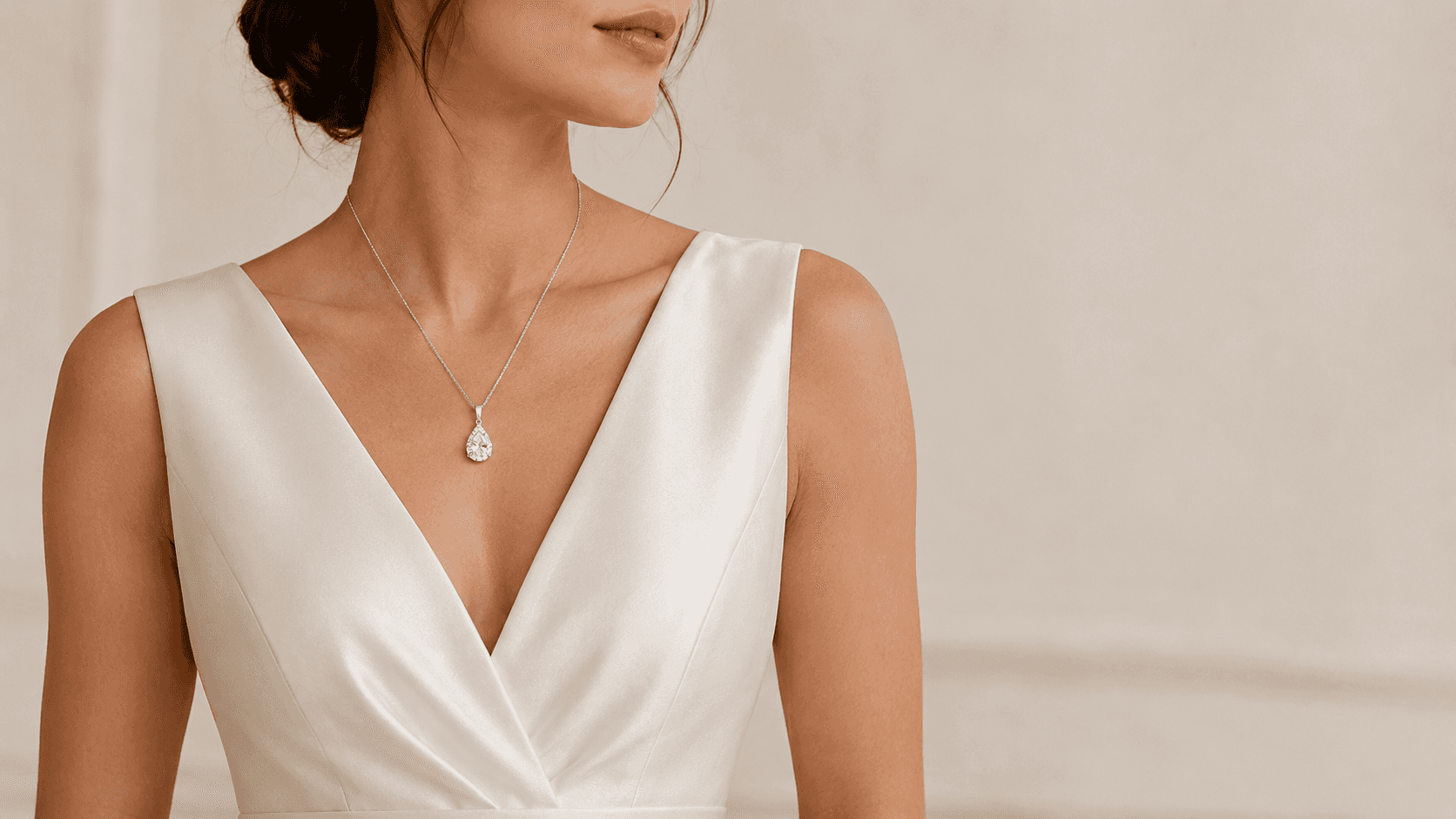
A diamond pendant is one of the most versatile pieces of bridal jewellery: refined enough to complement a wedding gown and wearable enough to remain part of your wardrobe long after the ceremony. Its apparent simplicity, however, makes every decision—from diamond shape to chain length—more visible.
What should a bride look for in a diamond pendant?
Choose the wedding dress first, then select a pendant shape and chain length that follow its neckline. Prioritize an attractive diamond, secure setting, properly proportioned bail and chain strong enough to support the pendant. The finished piece should remain centred, sit clearly above the gown and feel comfortable throughout the wedding day.
Why choose a diamond pendant for your wedding?
Unlike a broad collar or continuous diamond necklace, a pendant creates one controlled point of light. It can frame an open neckline without covering it and add jewellery to a bridal look without demanding that every other element become more elaborate.
Wearable after the wedding
A refined pendant can be worn with evening dresses, shirts, tailoring and simple everyday necklines.
One clear focal point
The pendant directs attention without surrounding the entire neckline with diamonds.
Easy to make meaningful
A pendant can incorporate an heirloom stone, symbolic shape, engraving or wedding-day gift.
Pendants work particularly well when the bride wants jewellery that feels special but not exclusively bridal. They can also provide a practical way to focus the budget on one visible diamond rather than dividing it among many smaller stones.
“A bridal pendant should appear to finish the neckline—not hang there because the bride felt something was missing.”
Diamond pendant styles explained
Solitaire pendant
One diamond forms the focal point. Because the design is simple, the proportion of the setting, bail and chain becomes especially important.
Halo pendant
A border of smaller diamonds surrounds the centre stone, creating additional brilliance and a larger visual outline.
Cluster pendant
Several diamonds form a single floral, geometric or abstract composition. A cluster can create impact without depending on one large stone.
Drop pendant
A vertical arrangement of diamonds or a suspended centre stone creates movement and works naturally with V-shaped necklines.
Motif pendant
Floral forms, stars, initials, crosses and other symbols can add meaning, provided the design remains connected to the bridal look.
Antique or heirloom pendant
An inherited or vintage design can introduce history and character. Condition, previous repairs and chain compatibility should be checked carefully.
Match the pendant to your wedding-dress neckline
| Neckline | Best pendant direction | What to consider |
|---|---|---|
| V-neck | Vertical pendant or drop | Follow the angle of the neckline and keep the pendant above the gown |
| Sweetheart | Solitaire, pear-shaped drop or soft cluster | Use the central dip without letting the pendant touch the bodice |
| Strapless | Almost any well-proportioned pendant | Adjust the scale according to the amount of bodice embellishment |
| Square | Short, symmetrical pendant | Keep it within the neckline’s structured frame |
| Scoop | Rounded cluster or central solitaire | Allow the chain to echo the soft curve of the gown |
| Off-the-shoulder | Short pendant or delicate drop | Balance the pendant with sleeves and shoulder details |
| Bateau or boat neck | Usually no pendant | A short pendant may crowd the high horizontal neckline |
| High neck or halter | Usually no pendant | Choose earrings or a bracelet instead of covering the dress |
Which diamond shape should you choose?
The diamond shape determines the character and direction of the pendant. It can repeat the geometry of the neckline, soften it or introduce a deliberate contrast.
Round brilliant
Classic and versatile, the round diamond suits almost every pendant style and works particularly well as a simple solitaire.
Oval
The elongated outline creates a slightly larger visual presence and a graceful vertical direction without a sharp point.
Pear
A pear-shaped diamond naturally directs the eye downward, making it especially suitable for sweetheart and V-neck gowns.
Emerald cut
Clean lines and broad facets give the pendant an architectural quality that complements minimalist and structured dresses.
Princess or radiant cut
Square or rectangular outlines create a modern, defined focal point and can work particularly well with square necklines.
Heart shape
A literal romantic symbol can feel appropriate for a wedding, but it has a distinct personality. Choose it because you genuinely enjoy the shape—not simply because it is bridal.
Diamond pendant settings explained
Prong setting
Fine metal claws hold the diamond while leaving much of it exposed. Check that every prong is even, secure and smooth.
Bezel setting
A rim of metal surrounds the diamond. The result can feel modern and is less likely to catch delicate bridal fabric.
Halo setting
Smaller diamonds encircle the centre, increasing the overall visual outline and introducing more detailed sparkle.
Minimal or illusion-style setting
These designs attempt to make the diamond appear lightly suspended. Inspect the construction and ask how the stone is secured.
Fixed versus sliding pendants
A fixed pendant is attached to the chain at two points and may remain centred more reliably. A sliding pendant moves along the chain and can be easier to replace or reposition, but it may travel towards one side as you move.
Pay attention to the bail
The bail connects the pendant to the chain. It should be strong enough to support the piece but proportionate enough not to overpower the diamond. Check that the chain moves freely through it and cannot slip through accidentally.
“In a solitaire pendant, every component is visible. Simplicity leaves nowhere for poor proportion to hide.”
The chain is part of the pendant—not an afterthought
A beautiful diamond on an unsuitable chain can rotate, sag, feel insecure or appear visually unbalanced. The chain must support the weight of the pendant while remaining consistent with its scale.
Chain thickness
An extremely fine chain may look delicate but can be too fragile for a substantial pendant. A heavy chain may distract from a small solitaire. Ask the jeweller whether the chain is appropriate for the pendant’s weight and intended frequency of wear.
Chain style
Fine cable, curb, box and other chain constructions behave differently. Look at flexibility, strength and how much the chain catches the light. The chain should complement the pendant rather than introduce a second decorative language.
The clasp
Test the clasp yourself. It should close decisively and remain easy enough to operate without creating uncertainty. A valuable pendant may justify an additional safety feature or a stronger clasp than the most visually delicate option.
Removable or permanently attached?
A removable pendant allows the chain to be replaced or used separately. A fixed design may remain better positioned and can form a more integrated composition. Neither approach is automatically superior.
Check the entire chain—not only the front
Inspect the clasp, jump rings, adjustment links and the point where the chain meets the pendant. These small components are often where wear or failure first appears.
How to find the correct pendant length
The same pendant can look completely different when moved only a few centimetres. Its ideal position depends on your proportions, the depth of the neckline and the size of the pendant itself.
Put on the gown
The actual wedding dress provides the only reliable reference for the neckline’s shape, height and movement.
Mark the ideal position
Use a simple chain or ribbon to identify where the bottom of the pendant should sit—not merely where the chain should fall.
Move naturally
Sit, turn and bend slightly. Confirm that the pendant remains above the dress and does not repeatedly strike the neckline.
Photograph the result
Examine close-up, portrait and full-length images. The pendant should remain visible without becoming disconnected from the complete look.
An adjustable chain can be useful, particularly if you intend to wear the pendant with different necklines after the wedding. However, adjustment adjustment links must remain secure and should not pull the clasp noticeably to one side.
How to evaluate the diamond
Because a solitaire pendant centres attention on one stone, diamond quality may be more individually noticeable than it is in a necklace containing many small diamonds.
Prioritize light performance
Cut strongly influences whether the diamond appears bright and lively. A larger but poorly performing diamond may look less compelling than a smaller, well-cut stone.
Consider the setting metal
White metals can emphasize colour differences, while yellow or rose gold may make a degree of warmth feel more integrated.
Judge what is visible
Look for a diamond that appears attractive without obvious distracting inclusions at normal viewing distance. Exceptionally high clarity may not create an equally visible improvement.
Weight is not visual size
Carat measures weight. Diamond shape, proportions, setting and cut influence how large the finished pendant appears.
Natural versus laboratory-grown diamonds
Natural diamonds may appeal for their geological origin, traditional associations and role in an heirloom piece. Laboratory-grown diamonds may allow a larger centre stone within the same initial budget.
The seller should clearly disclose the diamond’s origin and explain any grading documentation that accompanies it.
How to set a diamond pendant budget
Start by deciding whether the pendant is a wedding accessory or a long-term jewellery purchase. A piece intended for frequent wear may justify a different allocation from a pendant selected for one particular gown.
For a restrained budget
Consider a smaller well-cut solitaire, a laboratory-grown diamond, a bezel-set design, a cluster pendant or a pre-owned piece. Concentrating the design around one clear focal point can create elegance without elaborate construction.
For a moderate budget
Decide whether you prefer a larger central diamond, higher specifications, a halo, more substantial chain or a distinctive designer setting. Rank these qualities rather than attempting to maximize everything.
For a substantial budget
Larger diamonds, rare shapes, antique pieces and important designer pendants become possible. Documentation, provenance, insurance and long-term maintenance should receive proportionate attention.
Construction, security and bridal comfort
The pendant will move as you walk, greet guests and dance. It should remain comfortable and centred without requiring constant adjustment.
Inspect the setting
Prongs should be even and secure, while bezels should surround the diamond consistently without visible gaps or rough edges.
Test its balance
The pendant should face forward rather than tipping, rotating or continually travelling towards one side.
Check for snagging
Run a finger around the setting, bail and chain. Nothing should catch lace, tulle, hair or the edge of the gown.
Wear it for longer
A few seconds in front of a mirror cannot reveal whether the chain scratches, the pendant flips or the clasp shifts throughout the day.
Diamond pendant buying checklist
- Choose the wedding dress before finalizing the pendant.
- Confirm that the pendant shape complements the neckline.
- Measure where the bottom of the pendant will sit.
- Check whether the pendant is fixed or slides along the chain.
- Inspect the bail, setting, chain links and clasp.
- Ask whether the chain is suitable for the pendant’s weight.
- Confirm the diamond’s natural or laboratory-grown origin.
- Review the cut, colour, clarity and carat information provided.
- Ask what grading documentation accompanies the diamond.
- Check the complete metal and alloy composition.
- Read the return, alteration, warranty and aftercare policies.
- Try the pendant with the dress, earrings, veil and hairstyle.
- Photograph it from close, portrait and full-length distances.
- Arrange appropriate insurance for a valuable piece.
Frequently asked questions
What diamond pendant is best for a bride?
A solitaire pendant is the most versatile, while halo, cluster and drop pendants offer greater presence. The best choice depends on the gown’s neckline, embellishment and the bride’s personal style.
What pendant works best with a V-neck wedding dress?
A vertically oriented solitaire, pear-shaped diamond, drop pendant or Y-style design can follow the direction of a V-neck. Keep the lowest point clearly above the gown.
Can I wear a pendant with a strapless wedding dress?
Yes. A strapless neckline leaves ample space for a pendant. Adjust its scale according to the amount of embellishment on the bodice and the prominence of the earrings.
Should a bridal pendant match the engagement ring?
Exact matching is unnecessary. The pieces may be connected through diamond shape, metal colour or overall style, but thoughtfully mixed designs can also appear coherent.
Is a fixed pendant better than a sliding pendant?
A fixed pendant may remain centred more consistently, while a sliding pendant offers greater flexibility and may be removable from the chain. Construction and balance matter more than a universal rule.
Can the chain length be adjusted?
Many chains can be shortened or fitted with additional adjustment points. Ask before purchasing, as alterations may affect balance, warranty or return eligibility.
Are laboratory-grown diamonds suitable for bridal pendants?
Yes. They can offer a larger visible diamond within a particular initial budget. The seller should provide clear disclosure and appropriate documentation.
When should I buy my bridal pendant?
Purchase it after selecting the dress and early enough to test it during a fitting. Allow time for returns, chain alterations, documentation and insurance.
Choose a pendant that survives the wedding trend
The most successful diamond pendant complements the gown without becoming trapped inside one bridal look. Select the right proportion, length and construction, and it can remain meaningful long after the dress has been carefully stored away.